Muslim parents seek to instill a deep love for the Quran in children, beyond memorization, to foster Islamic identity, moral values, and a bond with Allah. Balancing traditional repetition with modern understanding involves playful, age-appropriate strategies, parental modeling, and tech tools like apps and AI. This holistic approach creates a joyful, lifelong spiritual connection.
What Is The Heart of the Matter For Kids Learing Quran?
Every Muslim parent holds a silent, fervent wish: that their child doesn’t just recite the Quran, but truly cherishes it. We aspire for more than rote repetition. What we’re really talking about is igniting a profound, spiritual connection – a lifelong dialogue with the Divine.
This isn’t merely about ticking off boxes on a religious checklist; it’s about cultivating a deep understanding, a lived experience of the Quran’s teachings. Why does this matter so deeply? Because it’s about building a robust Islamic identity, imbuing our children with unwavering moral values, and fostering an intimate bond with Allah through the prism of His sacred words. It’s about laying a foundation that will guide them through the labyrinthine complexities of life.
Way Back When – A Peek into Quranic Learning History
Let’s journey back in time, to the very genesis of Quranic education. Remember the kuttab and maktab? These humble, grassroots academies, often nestled beside the comforting familiarity of the local mosque, were the crucibles where generations of Muslims first encountered the Quran.
The old-school approach was characterized by repetition, imitation, and a meticulous focus on correct pronunciation (Tajweed) and memorization (Hifz). Discipline was paramount; a focused mind was considered essential for absorbing the Divine message.
But these institutions offered more than just verse recitation. They were holistic centers, dedicated to shaping character, instilling moral rectitude, and even imparting practical skills. We mustn’t forget luminaries like Ibn Sina, whose progressive ideas on education emphasized the importance of understanding alongside memorization.
The tapestry of time has woven significant changes, yet the core thread remains unbroken: the unwavering goal of shaping a child’s Islamic identity, nurturing their spiritual growth, and grounding them in the timeless wisdom of the Quran.
The Modern Parent’s Puzzle – Debates & Daily Hurdles
Herein lies the modern quandary: Is it more efficacious to prioritize rote memorization, or to emphasize deep understanding and practical application? Is it an “either/or” proposition, or can we achieve a harmonious synthesis of both?
Some argue vehemently for the primacy of early memorization, believing it lays the groundwork for future comprehension. Others express concern that a purely mechanical approach can lead to disengagement, a hollow recitation devoid of meaning.
Traditional lecture-style learning, with its emphasis on passive absorption, can feel anachronistic in a world saturated with the dynamic allure of platforms like TikTok. How do we bridge this chasm, making Quranic learning not just relevant but truly captivating?
Consider the question of timing: Is playing Quranic recitations for newborns sufficiently “early,” or should we wait until they possess the cognitive capacity to grasp abstract concepts? And what of the “mirror effect?” Children, particularly those aged 7-9, are remarkably perceptive, often mirroring the attitudes and behaviors of their parents. Are we embodying the Quranic values we seek to instill, or do our actions betray a disconnect?
The linguistic dimension presents another challenge: Is proficiency in Arabic indispensable for forging a genuine connection with the Quran, or can translations serve as effective bridges, particularly for those from non-Arabic speaking backgrounds?
The modern landscape is riddled with distractions, from the incessant ping of notifications to the allure of instant gratification. Overcoming these obstacles, cultivating focus, and nurturing a genuine interest in the Quran requires Herculean patience from parents and educators alike.
Lighting the Spark – Practical Strategies for a Joyful Journey
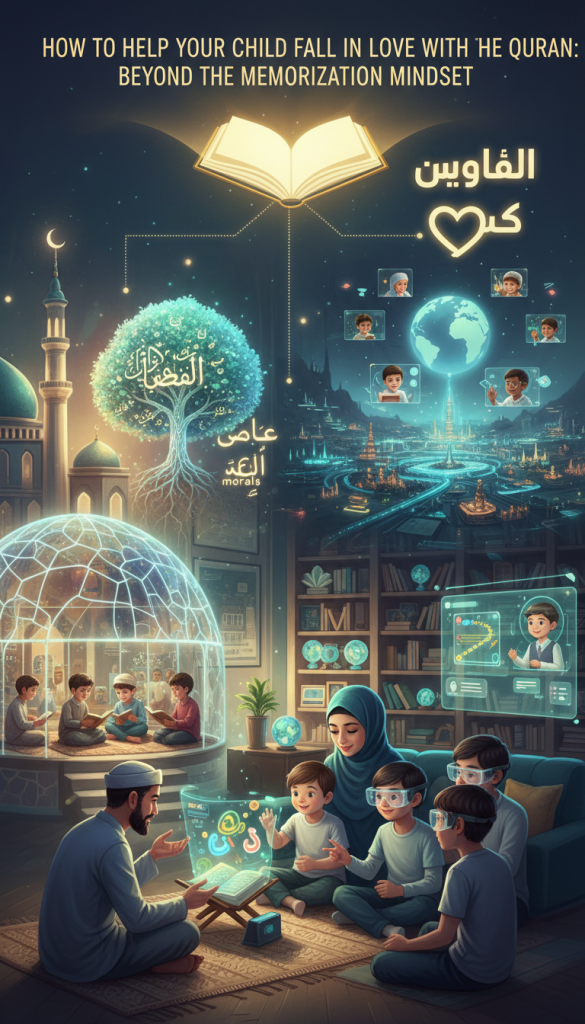
The key lies in transforming Quranic learning from a chore into an adventure. Embrace the power of play: games, puzzles, quizzes, flashcards, and storytelling can all serve as potent catalysts for engagement. Consider “Quran treasure hunts,” where verses lead to hidden “treasures” of Islamic knowledge. Fun is the secret ingredient, the vital spark that ignites a lifelong passion.
Create a home environment that resonates with the spirit of the Quran. Soft recitations playing in the background, a cozy study nook bathed in gentle light, and shelves overflowing with Islamic books can all contribute to a Quran-centric atmosphere.
Most importantly, be the example. Let your children witness your engagement with the Quran – reading, reflecting, and striving to embody its values in your daily life. Authenticity is contagious, and your actions will speak far louder than any words.
Remember that age is more than just a number; it’s a crucial determinant of your teaching style. For the tiny tots (3-6), imaginative play, simple stories, songs, and sensory experiences are the most effective tools. For the mighty middles (7-10), interactive learning, problem-solving, and collaborative group activities can foster a sense of ownership and excitement. And for the teen titans (11+), deep discussions on ethics, relevance to their lives, and critical thinking can transform the Quran from an ancient text into a living guide.
Go beyond the “what” and delve into the “why” and “how.” Connect verses to concrete actions – honesty, kindness, gratitude – demonstrating how the Quran’s teachings can be woven into the very fabric of daily life.
Above all, offer unwavering encouragement. Positive reinforcement, sincere praise, and celebrating every milestone, no matter how small, will fuel motivation and nurture a sense of accomplishment.
Consider enlisting the aid of a qualified, engaging teacher who specializes in children’s education. A skilled educator can tailor their approach to your child’s individual needs and learning style, making all the difference in their Quranic journey.
The Future is Now – Tech-Savvy Quranic Adventures
The digital age has ushered in a new era of Quranic learning, offering unprecedented opportunities for engagement and personalization. Online learning platforms, interactive apps, and podcasts provide learners with the flexibility to learn at their own pace, from anywhere in the world. Imagine connecting with a global community of teachers and students, transcending geographical boundaries in pursuit of knowledge.
Consider the potential of AI: personalized learning pathways, adaptive feedback, and AI-powered progress tracking can tailor recommendations to each student’s unique needs. Gamification is transforming Tajweed practice and memorization into exciting virtual challenges and Islamic trivia competitions.
Multimedia presentations, animated stories, and even the future possibilities of VR/AR for virtual tours of historical Islamic sites or simulated Hajj experiences can create immersive learning environments that captivate and inspire.
Live virtual classrooms, discussion forums, and online communities can foster connection and shared learning, creating a supportive network of peers.
Perhaps the most promising development is the emergence of hybrid curricula that seamlessly blend Quran, Hadith, and Islamic values with modern academic subjects, fostering a holistic, well-rounded Muslim identity equipped to thrive in the 21st century.
Conclusion: A Lifelong Love Affair
Nurturing a love for the Quran is not a sprint, but a marathon. It demands unwavering patience, boundless creativity, and a holistic approach that addresses the intellectual, emotional, and spiritual dimensions of learning.
The ultimate prize is to equip our children with a heartfelt, enduring connection to Allah’s book, guiding them towards a righteous, purposeful, and prosperous life. Let us strive to make their Quranic journey a cherished adventure, a lifelong love affair with the Divine Word.